2005年8月26日金曜日

Metal-Assembling Dendrimers with a Triarylamine Core and Their Application to a Dye-Sensitized Solar Cell


N. Satoh, T. Nakashima, K. Yamamoto
J. Am. Chem. Soc. 2005, 127, 13030-13038.

Metal-Assembling Dendrimers with a Triarylamine Core and Their Application to a Dye-Sensitized Solar Cell

A series of charge-separable and hole-transporting phenylazomethine dendrimers with a triarylamine core are prepared and evaluated for use as a charge separator in dye-sensitized solar cells (DSSCs). Triphenylamine with dendric phenylazomethine (TPA-DPA) is prepared by synthesizing up to five generations of dendrons using a convergent method. The resultant dendrimer has a rigid sphere structure similar to globular protein, with a hydrodynamic radius of 2.43 nm. Electrochemical oxidation of the TPA core reveals that the dendron units in the dendrimer have 0.35 of the attenuation factor (β) in the electron transfer. Complexation of TPA-DPA with SnCl2 proceeds in stepwise fashion from the core to the terminal imine following the basicity gradient among imine groups in each dendron shell. DSSCs prepared by casting these dendrimers onto dye-sensitized TiO2 film exhibited a higher open-circuit voltage than the bare film through the suppression of back electron transfer. The generational growth of dendrons increases the radius of the dendrimer, resulting in a stronger association with I3- and higher open-circuit voltage with an increasing number of generations. Complexation with SnCl2 reduces the resistance of TPA-DPA and improves the fill factor. The energy conversion efficiency of the DSSC prepared using fifth-generation TPA-DPA is 21% higher than that for the bare film and, when complexed with SnCl2, provides a 34% improvement.

2004年1月27日火曜日

Fine Control of the Release and Encapsulation of Fe Ions in Dendrimers through Ferritin-like Redox Switching


R. Nakajima, M. Tsuruta, M. Higuchi, K. Yamamoto
J. Am. Chem. Soc. 2004, 126, 1630-1631.

Fine Control of the Release and Encapsulation of Fe Ions in Dendrimers through Ferritin-like Redox Switching

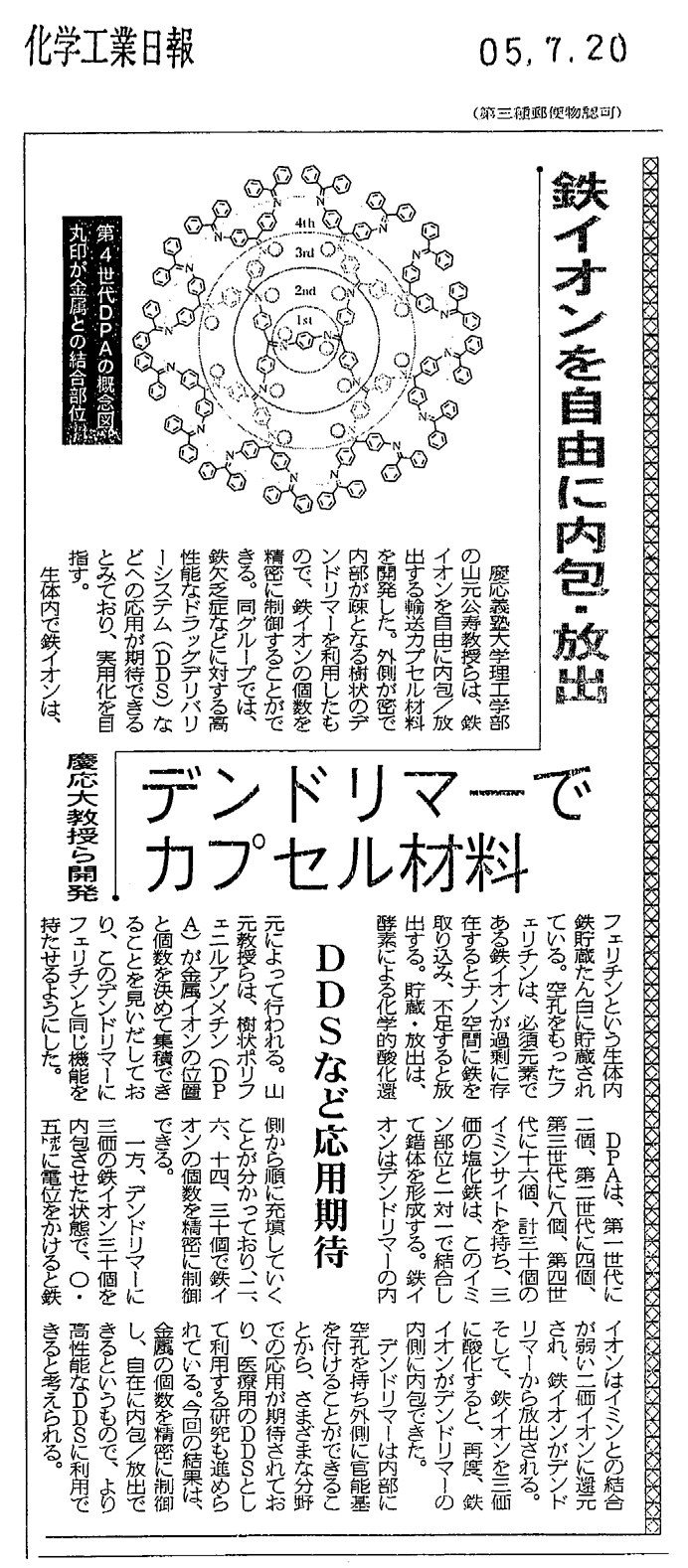
Numerous dendrimers incorporating metal ions or clusters have received much attention as catalytic and drug delivery materials. We expanded the variety of metal ions that complex with DPA through a radial stepwise complexation to create novel organic−inorganic hybrid materials. As one of the most common and significant iron ions, Fe3+ was used. It was confirmed that iron ions, FeCl3, are coordinated to the imine groups of a spherical phenylazomethine dendrimer (DPA) in a stepwise radial fashion, which should make it possible to control the number and location of the Fe3+ ions incorporated into the dendrimers. Iron possesses very interesting properties such as magnetism, redox chemistry, and catalysis and is also one of the essential elements of our body. Here, we show the first successful attempt to control the biomimetic switching of iron ions' release/encapsulation in the dendrimer driven by their redox response of the Fe2+/Fe3+ couple, which might find uses as a drug delivery system.